
One Quick Update; Two Preventable Crashes; Three Things You Can Do
One Quick Update
Hasting Street continues to be the epicentre of driver violence in our city.
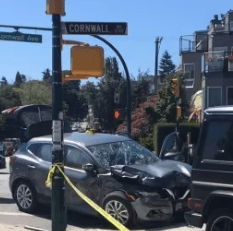
On March 27, three people were sent to the hospital after being hit by an Uber driver.
Police said speed wasn’t a factor, but look at that windshield. Whether or not the driver was technically speeding, they were driving too fast for safety.
Three Things You Can Do
Protecting People on Cornwall Avenue
- Six pedestrians or cyclists are hit by drivers and 27 people are killed or injured in car crashes on Cornwall each year.
- On Wednesday, April 26, Council will debate a motion to reduce the speed limit between Burrard and Trafalgar to 30km/h.
- You can speak or write to Council in support of this motion by Councillors Christine Boyle and Pete Fry.
- OneCity also has a petition that you can sign.
- Check out our Action Guide here.
Bute Greenway Project
- The City is looking for feedback on improving the Bute Greenway. We think their design actually looks pretty great! A permanent plaza, wider sidewalks, and better cycling connections.
- Please let the City know your thoughts; the survey closes April 30th.
Comox School Streets Program
- In 2021, a pilot project was launched, closing a 1-block stretch of Comox Street to cars. Now, they’re considering making it a permanent change!
- Tell them you love that plan. If they get an overwhelmingly positive response, they’ll know there’s an appetite for more.
Two Preventable Crashes
Throwback to July last year, when a 5-year-old girl was critically injured by a driver on Cornwall Ave. There’s a motion before Council to slow cars here and prevent this from happening again. More on that below.
Cars (and the people who drive them) are scary. If we design streets in ways that prevent speeding, this would never happen.


TOP STORIES
Anti-Bike City: ABC Vancouver Council kills active transportation lanes on Broadway
Wait what? In 2023?
You heard it. Despite the only east-west options on this busy corridor being shared side-streets where cyclists regularly get doored, ABC decided to kill a planned active transportation lane.
A little background
In Summer 2022, Councillor Christine Boyle led a motion to direct staff to include a bike lane on Broadway. That motion passed.
With the rebuilding of Broadway following the construction of the subway, it’s the perfect opportunity to plan for reduced vehicle traffic, promote active transportation, and improve street safety for all users.
So why’d they kill it?
City staff came back with a report that had a few options, recommending heavily against bike lanes.
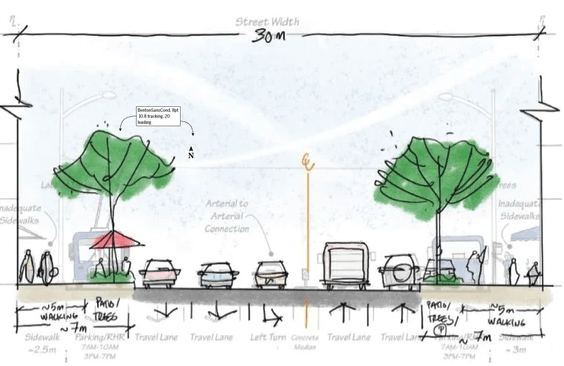
(1) 4 car lanes and no bike lane, (2) 4 car lanes, bike lanes, smaller sidewalks, (3) 2 car lanes, bike lanes, and big sidewalks. They said two vehicle lanes weren’t enough for turning, buses, and emergency vehicles.
Yes, but
The report was awful. It was an exercise in climate denial, never once using the words “sustainability” or “climate change,” despite the subject matter having direct relevance to the city’s climate action.
It also didn’t once use the word “safety” 🤦 That’s not an exaggeration. Staff didn’t consider street safety when proposing to remove active transportation infrastructure from the plan.
Many people also pointed out that the wider sidewalks are less useful if there are four lanes of noisy polluting cars.
There were also alternatives that weren’t explored, like 3 lanes.
So what
Sadly this means that maybe someday we’ll get active transportation infrastructure along Broadway, and we’ll pay more for it compared to doing it now.
Businesses will suffer. Cyclists & scooters will be forced onto the sidewalk or dangerously into the shared roadway when accessing subway stations, homes, or businesses. People will get hurt and some will die.
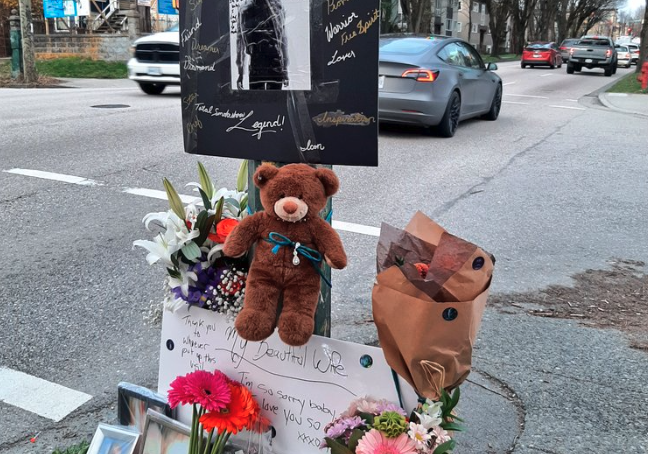
Traffic Deaths are not Unpredictable
What’s wrong with 1st?
Anyone who lives near 1st Avenue knows that drivers regularly speed along the narrow lanes that connect downtown to the highway. In the Grandview-Woodlands neighbourhood, it’s a dangerous road to cross.
And what’s wrong with this intersection?
- Speeding drivers, particularly downhill, with amped up frustration from congestion on the highway or leaving downtown.
- Very short signal time, leaving too little time for pedestrians to make it across before impatient drivers start moving.
- Backed-up traffic at 1st or Clark often leaves cars blocking the intersection.
Yes, but
The City claims the walking time is set to the maximum possible, at 1m/s, apparently. This might be sufficient for the average person, but it leaves 8 seconds, or less if you’re being safe and waiting for potential (and frequent) red-light skippers to come to a complete stop.
So what
This will happen again, because the city is officially stating “Reviewed and no action planned.”
E-Bike Lending Program Coming to North Vancouver?
What’s an E-Bike Lending program?
Councillor Jordan Back has proposed that the District of North Vancouver’s libraries purchase 3-4 electric cargo & utility bikes to be lended out – like a book.
Why?
The barrier for buying a new electric cargo bike is pretty high. This is a great way to try it out.
Shut up and take my money
Well, you won’t have to worry about that. This program will offer e-bikes free of charge!
BETTER JOURNALISM
Introducing our Media Style Guide
At Vision Zero, we see a lot of bad reporting on traffic violence. So we created a Media Style Guide!
The goal of this guide is to help shift the tone of coverage of tragic crashes away from victim blaming and an air of inevitability, and towards contextualizing the incidents in terms of road design and community impact.
With that in mind, here’s how we might have written the story above about a crash on Hastings St:
Three pedestrians were sent to hospital, with two of them in critical condition, after being hit by a driver Saturday evening.
BC Emergency Health Services said it received a call around 7 p.m. for a collision near East Hastings Street and Campbell Avenue in downtown Vancouver. Footage from the scene shows a white Nissan hatchback car with a heavily cracked windshield, also sporting Uber and Lyft decals.
Hastings Street is the most dangerous street for pedestrians in the Lower Mainland, with over 45 pedestrians hit by drivers every year between 2016-2020, according to ICBC.
A decade ago, the City of Vancouver implemented a speed limit of 30 km/h in the most dangerous section between Abbott and Jackson Avenues; however, this crash happened 4 blocks east of Jackson, where the speed limit is 50 km/h. At this speed, the majority of pedestrians hit by vehicles tragically succumb to their injuries.
This area of Hastings St is a mixed commercial-residential zone, with several multi-unit apartments, restaurants, and shops. Hastings St is 6 lanes wide, which makes it difficult to cross safely. More updates will be provided as they become available.
WATCH / LISTEN / READ
Watch
Check out this oldy but a goody. Traffic Calming is Everywhere by Not Just Bikes.
- All streets should be safe. All streets should be “calmed.”
- It’s only 5 minutes. Enjoy!
Listen
The popular podcast, 99% Invisible ran a great episode on the Dutch struggle for cycling infrastructure.
- Did you know that an important popular campaign in the 1970s had the subtle-as-a-smack-in-the-face name “Stop Child Murder”?
- They blocked major intersections and aggressively organized parents of victims 🤔
- Give it a listen while you’re cooking or walking the dog!
Read
Traffic Studies are ‘Junk Science’
- Traffic studies tend to wildly overestimate trends in car traffic growth.
- “We can’t widen sidewalks or build bike lanes. We can’t allow retail spaces or apartment buildings. Where will all the cars go??”
- This one feels particularly relevant in light of the City of Vancouver’s recent bike lane assessment that didn’t take into account safety or sustainability. Give it a read.
 Vision Zero Vancouver