
We at Vision Zero Vancouver are thrilled to see Councillor Pete Fry’s motion come to council on Vancouver’s Commitment to Safer Slower Streets. This is a broad Vision Zero motion that directs staff to look into and provision options for blanket 30 km/h speed limits in all residential areas in the city and on expressways, arterial and collector roads, physical infrastructure to improve road safety, and modal filtering and upgrades to local street bikeways. This motion addresses the single biggest threat to public safety in Vancouver with a multi-pronged approach that we enthusiastically endorse and wish to see pass as soon as possible.
Mistakes Should Not Be Fatal: The Case for 30 km/h Speed Limits
Whether driving, walking, cycling or rolling, people make mistakes. Speed is the strongest contributing factor in fatal motor vehicle crashes, followed by driver distraction and driver error[1].
A 30 km/h speed limit is a widely accepted standard that reduces the incidence of pedestrian fatality or serious injury upon collision 8-fold compared to 50 km/h. Internationally, it has been recognized that any roads with significant pedestrian traffic should be designed for 30 km/h – in fact this has been implemented in many countries across the world for years with proven benefits. Speeds below 30 km/h where people in and outside of vehicles mix is essential to achieve Vision Zero, and has recently been endorsed by the World Health Organization as well as the European Commission and OECD International Transport Forum[2],[3],[4],[5].
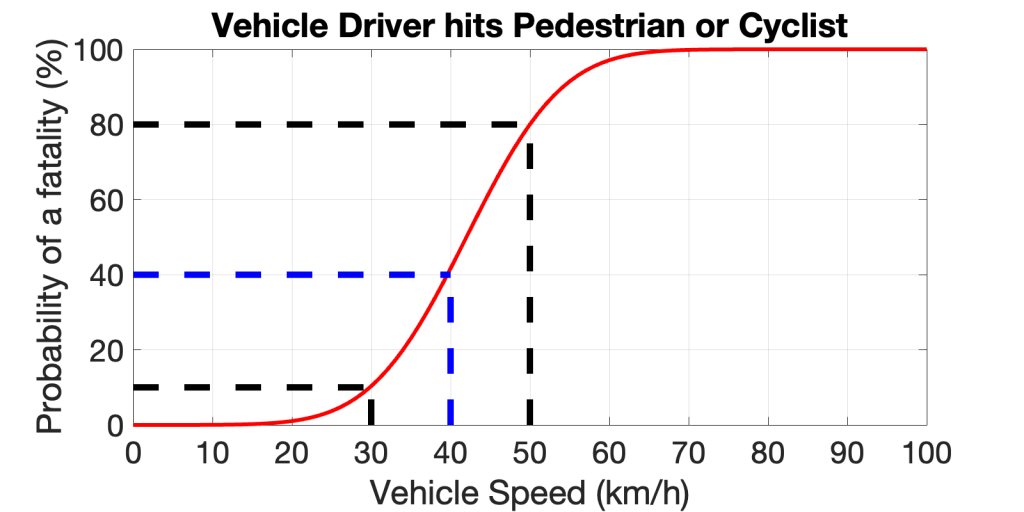
We at Vision Zero Vancouver advocate for a holistic approach to achieving safer streets that is well-exemplified by Councillor Fry’s motion:
- Blanket reductions are more easily understood by drivers and result in lower speeds than spot reductions of individual streets
- Signage and bylaws designating speed limits have a small but still statistically significant effect on speeds and safety, and enable traffic engineers to design roads for posted limits when roads are resurfaced
- These factors make reducing speed limits one of the most cost-effective measures to create safer cities
- Traffic calming infrastructure and engineering controls are the best way to achieve safer vehicle speeds and we are glad to see that this is also addressed in the motion
It is notable that essentially every jurisdiction that has achieved a measure of success in their Vision Zero goals has done so by broadly reducing speed limits to 30 km/h[6],[7].
More than Just Speed Limits: We Need Concrete Infrastructure Too!
We are pleased that the motion also addresses Vancouver’s lagging active transportation infrastructure by introducing measures to bring these routes up to the city’s own stated “All Ages and Abilities” network standards. Many of Vancouver’s existing bike routes have nothing but signs or painted sharrows, leaving active transportation users completely unprotected on streets with high vehicle volumes. The modal filtering and infrastructure proposed in the motion is direly needed and very welcome.
If we are going to reach zero deaths & serious injuries on our roads in any reasonable time frame, staff need a strong direction from Council asking them to implement the changes that are proven to prevent dangerous collisions and improve safety. This motion provides that clear direction and represents a huge opportunity for Council to vote according to their stated values of improving public safety, supporting active mobility, and improving the quality of life for the citizens of Vancouver.
Always Room for Improvement
Wherever people inside of cars interact with people outside of cars, the speed limit should be 30 km/h or lower. We know pedestrian fatalities happen primarily on busy arterial roads with businesses such as Broadway, Hastings, 4th Avenue, Main Street, and 16th Avenue. We call on council to reduce the speed to 30 km/h on these larger surface roads with high commercial use.
Enforceability is a Problem to Be Solved, Not an Excuse
We have previously heard “enforceability” raised as a reason to not limit drivers to safe speeds. Citizens should not tolerate a failure to enforce the law as a reason to tolerate unsafe laws. We reiterate our support for self-reinforcing road design, as well as automated speed enforcement.
About: Vision Zero Vancouver is a volunteer citizen advocacy group working to end traffic crashes resulting in death and serious injury in the Lower Mainland. We advocate for traffic safety changes, with an emphasis on safe-street design, diverse transportation options, and the prioritization of human life above motorist convenience.
[1] https://public.tableau.com/app/profile/icbc/viz/QuickStatistics-Contributingfactors/Contributingfactors
[2] https://www.itf-oecd.org/global-consensus-achieved-road-safety
[3] https://www.itf-oecd.org/sites/default/files/docs/safe-system-in-action.pdf
[4] https://www.who.int/news/item/22-03-2021-campaign-launched-to-make-30-km-h-streets-the-norm-for-cities-worldwide
[5] https://urban-mobility-observatory.transport.ec.europa.eu/news-events/news/stockholm-declaration-wants-general-30-kmh-speed-limit-2020-03-12_en
[6] https://www.gov.wales/introducing-default-20mph-speed-limits

