
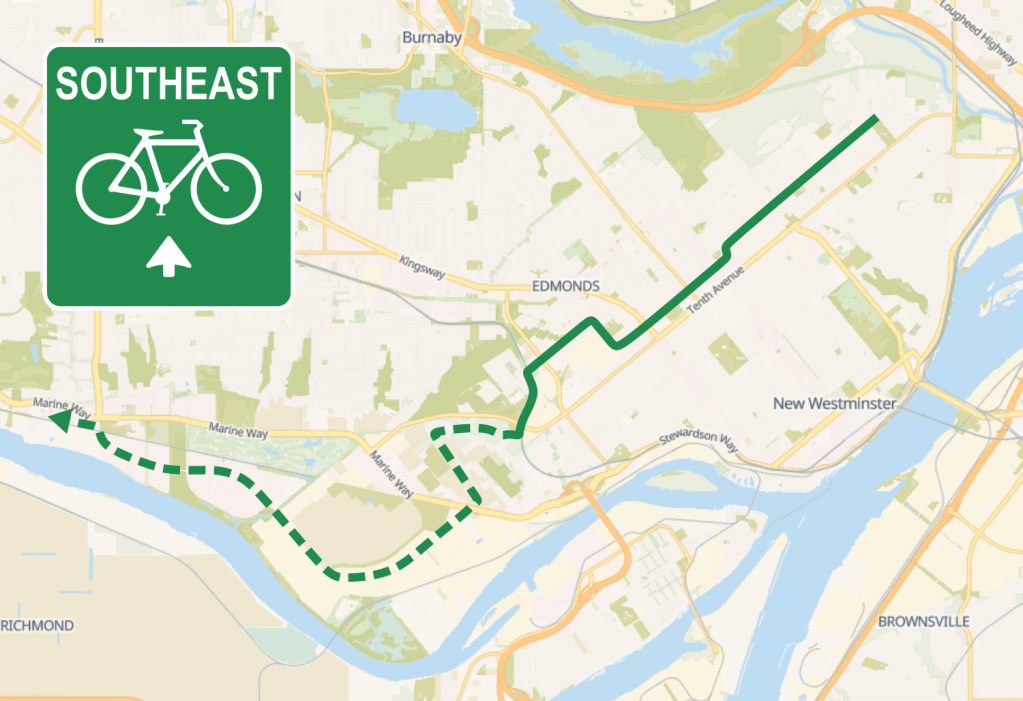
The City of Burnaby is seeking feedback until October 5, 2025 on the Southeast Bikeway Upgrade Project, which attempts to create a safer cycling connection between Vancouver’s Kent Ave bike route at Boundary Road and Cariboo Road in Southeast Burnaby.
The survey is split into two parts: proposed improvements to the existing Southeast Bikeway east of the BC Parkway, which is largely unprotected, as well as a proposal to create a brand new bike route west of the BC Parkway in the Big Bend area. You can choose to give feedback on either or both of the segments.
While we’re excited for a new safe cycling connection between Kent Avenue, Fraser Foreshore Park and the BC Parkway, we aren’t very impressed with the proposed upgrades to the existing portion of the Southeast Bikeway. Indeed, there’s a real possibility it would make the cycling experience worse along that route.
Disconnected and Disinterested
Along the existing Southeast Bikeway between Cariboo Rd and the BC Parkway, the City of Burnaby is proposing to upgrade the route to make it safer for cyclists, using a mix of on-street local street bikeways and off-street multi-use pathways. But is it really an upgrade?
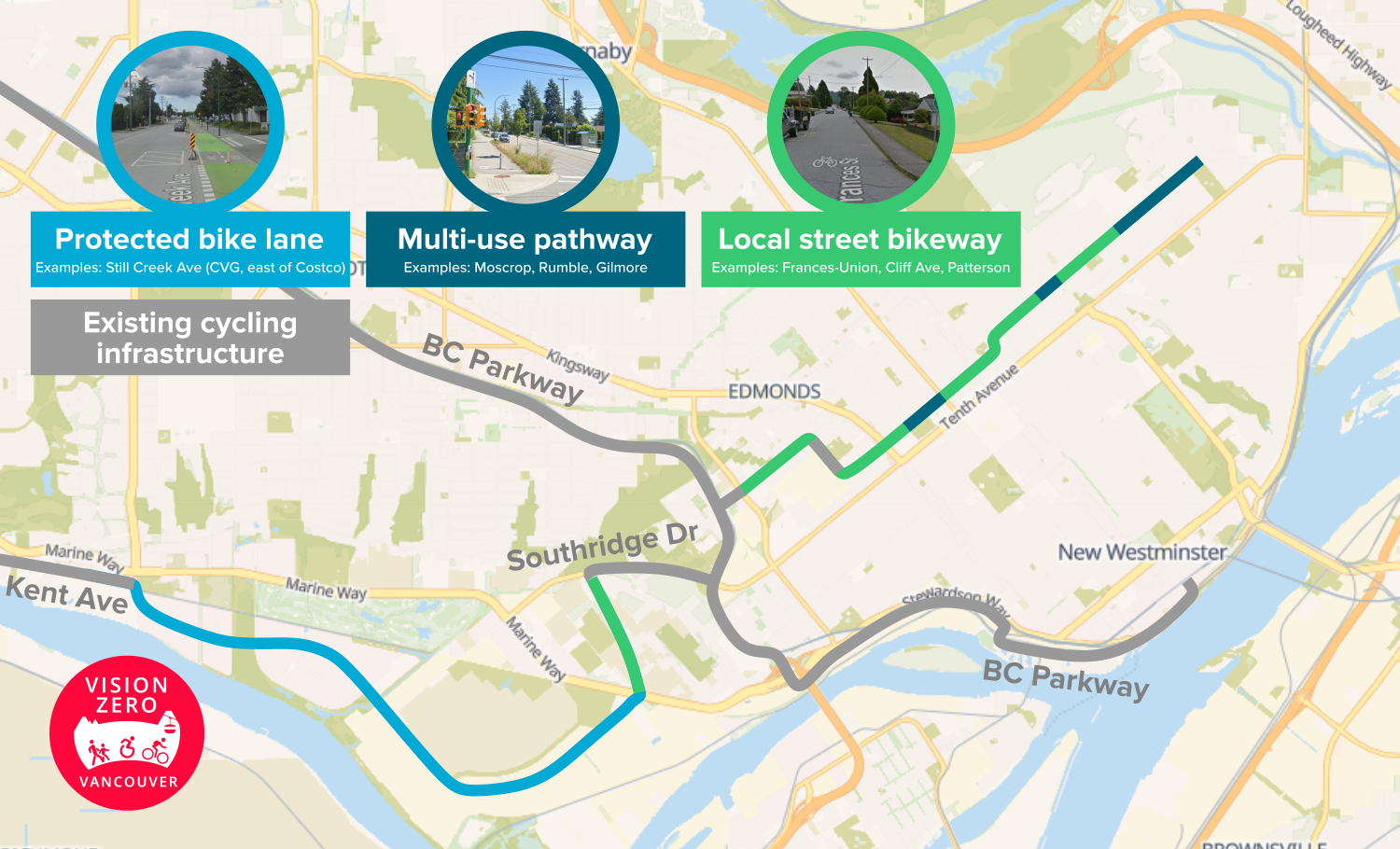
Multi-use pathways can be a cost-effective way to create protected cycling infrastructure, especially in areas with relatively low pedestrian and cyclist volumes. However, the devil’s in the details.
Here, the pathways that Burnaby proposes to create are 200-1000 metres long, and then spit cyclists back out onto the road. Inconsistent paths like these create conflict and are confusing for both cyclists and drivers.
It’s a lose-lose scenario: if cyclists take the pathway, they will be weaving in and out of the road every few blocks—which is both indirect and confusing for all road users at the merge points. If they stay on the road, they don’t get any benefit from the new infrastructure while being subjected to road rage from drivers who demand that they go onto the pathway.
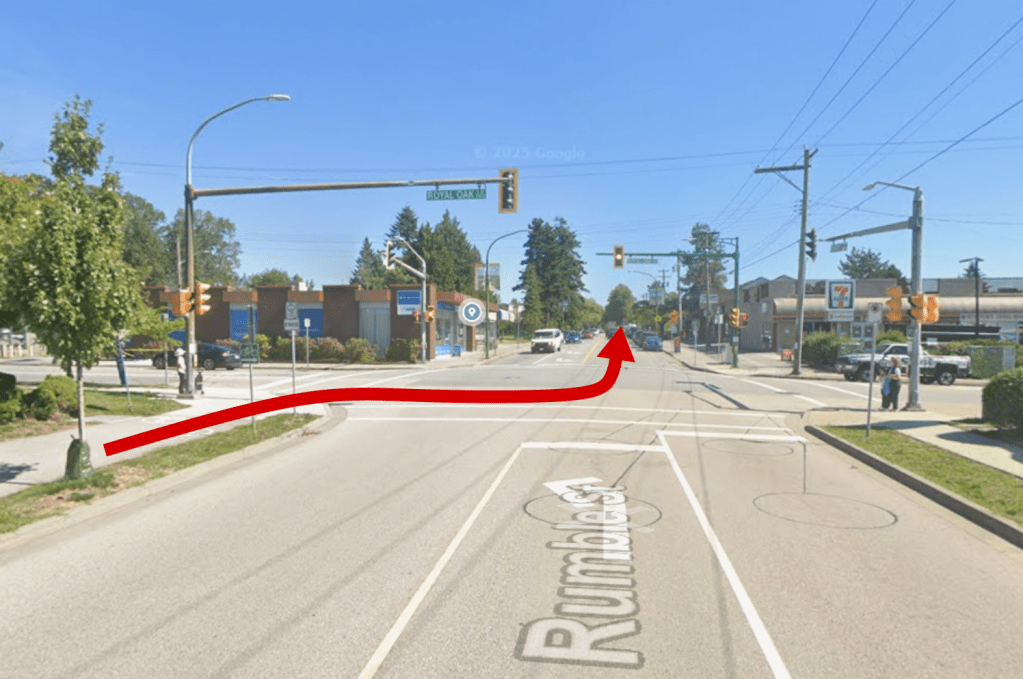
To avoid as much conflict and confusion as possible this proposal should either be a multi-use path the entire way, or bike lanes the entire way. Separated bike lanes could be easily accommodated by removing one parking lane or converting some of these streets to one-way traffic.
Take Action
Burnaby is taking public feedback on its Southeast Bikeway plans until Sunday, October 5. Click this link to be taken to the survey page.
We suggest that you make the following comments in the survey:
- Cyclists going on and off 200-400m sections of pathway to and from the street will create conflict with drivers
- Instead being broken up, this should be a complete protected bike lane or pathway all the way from Cariboo Heights to Edmonds
If Burnaby wants to make meaningful progress towards its safety, climate, and mode shift goals, they need to do a lot better than this piecemeal bike route. We need to build a connected, convenient, safe bike network to make people feel safe enough to actually use it.
This on and off path won’t serve current cyclists who are comfortable with the road because they will just stay on the road, and it won’t serve new cyclists because none of the paths are long enough to be useful. A broken up pathway communicates that the point is to get bikes out of the way of cars, not to provide safe transportation pathways for them.
More Info About Individual Segments
12th Ave (15 St to Canada Way)
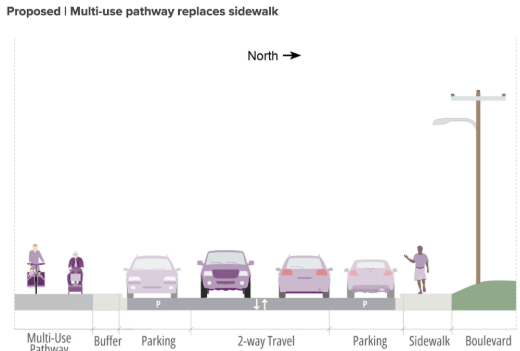
Starting from the western side of the route, the city is proposing 450 m of multi-use paths. The cul-de-sac side would actually be a fairly smooth transition from pathway to street, but the Canada Way side has the potential to be confusing.
The survey doesn’t specify what improvements would be made to this crossing, and transitioning from biking on the street to the multi-use path on the opposite side of the street has the potential to take longer than the current set up. And this is for access to a pathway that cyclists will only be on for one minute, if they even opt to go on the pathway.

How will we be expected to cross? As someone who already cycles this route, sometimes on an e-bike, if going west I probably would just stay on the street and not even bother going on to the multi-use path to use it for one minute unless the crossing was made very obvious, convenient and safe.
12th Ave (Canada Way to 4th St)
Two options are being proposed for this section: option one is gateway treatment (or “banana barriers” as some like to call them), and option two is one way eastbound traffic. Option two is preferred because it has greater potential for traffic reduction than option one.
Reducing traffic is a good step, but this is still a far cry from a safe AAA cycling route.
13th Ave (1st St to Newcombe St)
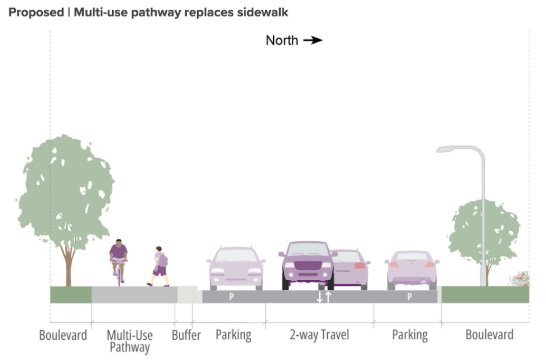
230 m of multi-use pathway is being proposed on this stretch in front of a school, a church, and single family homes. Currently, half of this block lacks a sidewalk on both sides, so this is an improvement for that half, but as for the rest of it this just isn’t a very useful path.
During school pickup and drop off times it will be very busy, and cyclists passing through won’t want to use it. It might be useful for school pick up or drop off via walking or biking, but there is no all-ages-and-abilities bike network to connect to once they go one block away from the school. If you were to let your kid bike there themselves, as soon as they are off that block they are at risk of being hit by a driver.
Outside of school pickup and drop off, it also isn’t very useful to cyclists, because needing to awkwardly go across two crossings to go onto and another two to get off of the pathway that they’ll be on for a grand total of 30 seconds will not be an attractive option.
Armstrong Ave (Cumberland St to Cariboo Rd)
One continuous kilometre of multi-use pathway is the best this project has to offer.
Unfortunately, it will require relocating utilities and lamposts to accommodate it. The city could very easily and very cheaply remove a lane of parking, plunk down some concrete to make uni directional, protected active transportation lanes. But because it might upset the drivers who park on this street they will spend tens of thousands of dollars out of the active transportation budget to dig up the sidewalk and lamposts. Improving active transportation doesn’t have to be expensive, it just requires political courage reallocating some of the road space that is hogged by private vehicles.
Spot treatments
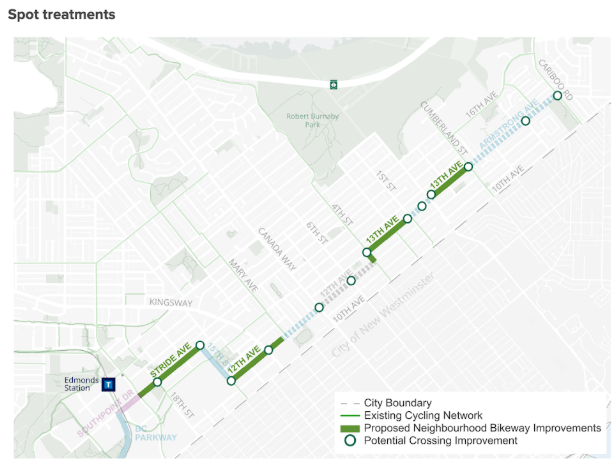
It’s been a bit confusing to follow this upgrade plan, because the upgrades are so sporadic. In between the sections of multi-use pathways and local street bikeways, they are considering spot treatments to improve cycling conditions. It sounds like they are considering speed humps and better signage to denote the bike route. We like speed humps, but we like physically separating vulnerable road users from dangerous road users even more.
 Vision Zero Vancouver