
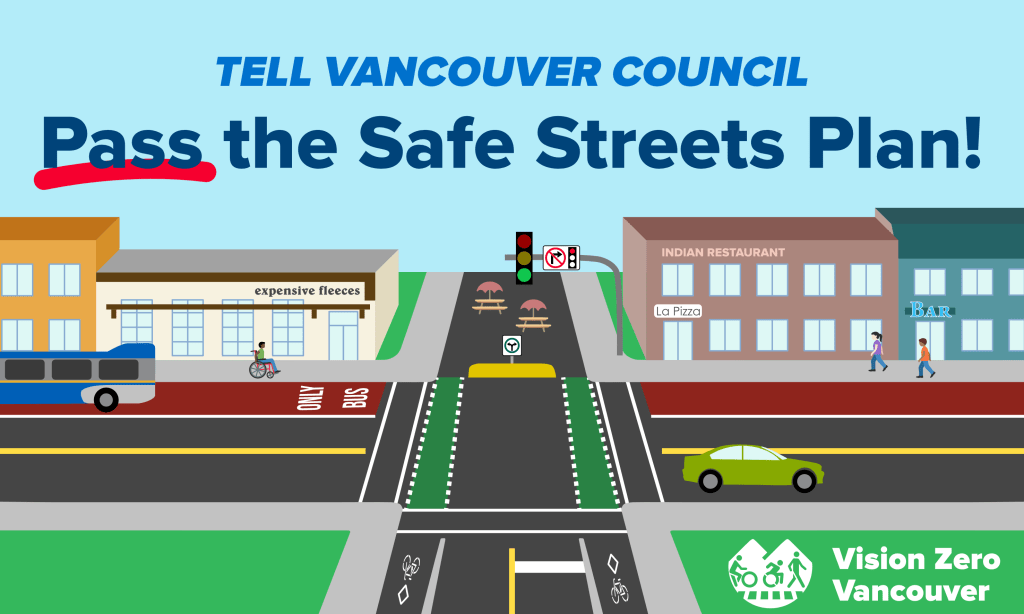
On June 2nd, Vancouver City Council will vote on whether to adopt the new Vision Zero Safe Mobility Plan. The plan is really good, and it’s not a given that Council will pass it. We need your support.
The plan commits the city to reducing fatalities and serious injuries on our roads by at least 5% every year, reaching zero by 2050. It outlines five key strategies and several near-term actions to be completed in the next five years. Lower speed limits, transit priority, safer vehicle regulations, automated enforcement, a connected all ages and abilities bike network—you name it, it’s here.
What’s the plan about?
Last summer, Council unanimously adopted Councillor Lucy Maloney’s motion to order staff to renew the City of Vancouver’s outdated vision zero plan, focusing on evidence-based solutions instead of endless studies.
In December, Council further directed staff to incorporate Cllr Lucy Maloney’s motion to expand no-right-turn-on-red at high risk intersections and Cllr Sean Orr’s motion to collect better data about road fatalities.
After extensive consultation with industry, communities and road safety experts, staff are now ready to unveil the city’s new Vision Zero plan.
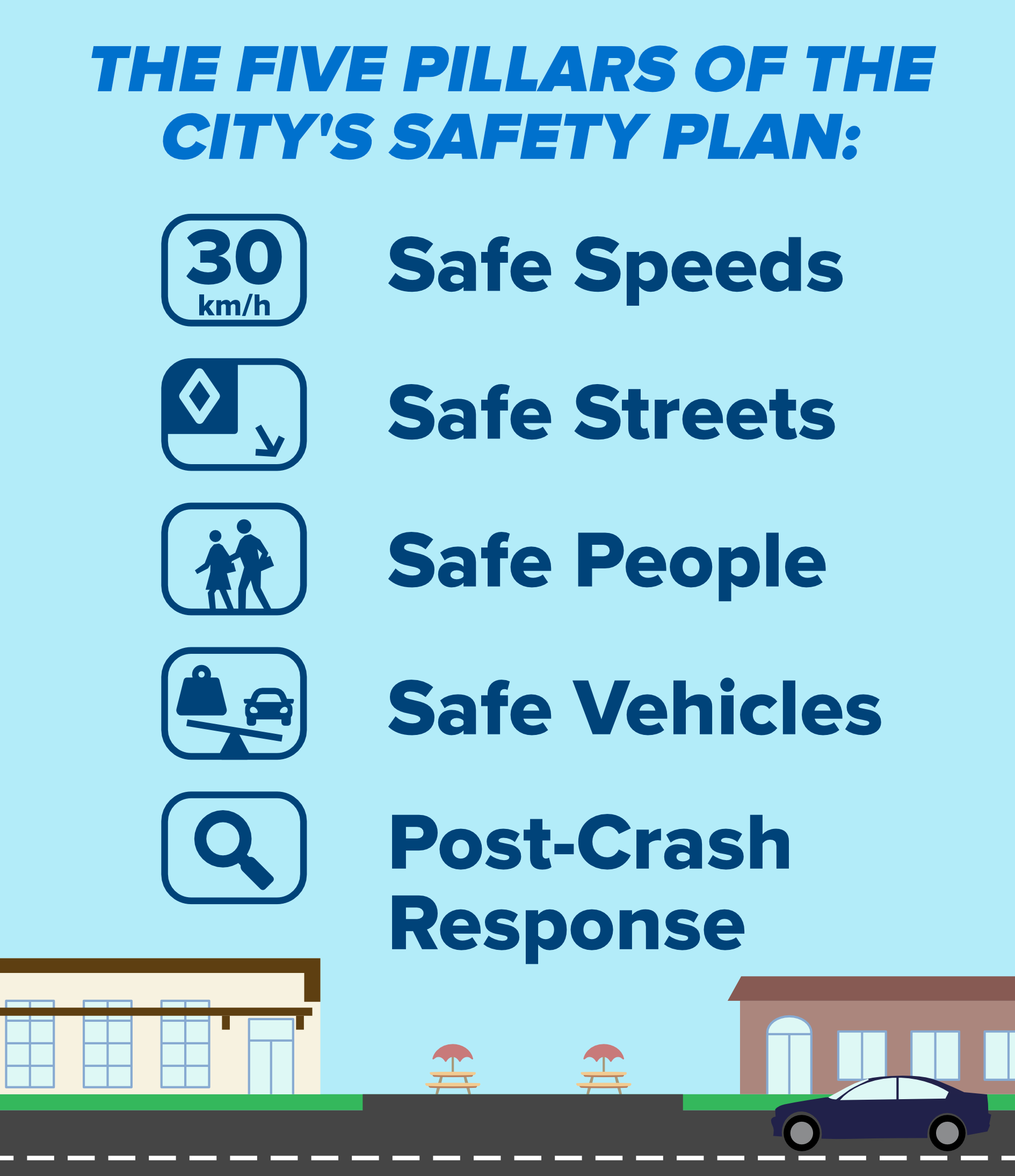
The plan uses the five elements of the Vision Zero approach as a framework to eliminate all fatalities and serious injuries on our roads by 2050, with meaningful progress each year.
This is a safe system approach that recognizes that road violence is not a personal moral failing but a systemic crisis that can only be solved by tackling every aspect of the problem, much like occupational safety and aviation safety.
What specific policies are included?
Speed is the number one contributing factor to fatal crashes, and the underlying foundation of this plan. While the city is gradually lowering speeds on side streets, arterials are where 93% of fatalities and 88% of serious injuries occur. Slower is safer—this is both intuitively obvious and very well supported with data from all over the world.
Key strategies from the plan include:
- Continuing roll-out of the city’s 30km/h speed limit on local streets
- Reducing the speed limit to 30 or 40km/h on select arterial and collector streets
- Using traffic calming to encourage appropriate speeds
- Implementing transit priority measures alongside reduced speed limits on busy bus corridors, like dedicated bus lanes, in-lane stops and signal priority
- Timing green lights so that drivers get a ‘green wave’ at a slower speed
The design of a street should encourage the travel behaviour we want to see. People intuitively drive slower and with more caution on streets with traffic calming. These designs are also forgiving: people will still make mistakes, but design has the power to make those mistakes less catastrophic.
Key strategies include:
- Addressing hotspots by prioritizing locations with a significant serious injury history, and considering equity factors (like higher numbers of children)
- Using a design toolkit of proven interventions, including: leading pedestrian intervals, shortened crossings, road diets, improved lighting, bus lanes, raised crosswalks, corner bulges, intersection daylighting, dedicated left turn bays, and no right turn on red… among many other things!
- Building a comprehensive active travel network for people of all ages and abilities, and considering low-cost, quick build approaches that can be upgraded over time
- Building safety and accessibility into the design of all new streets from the get-go
Rest assured, this is not the victim-blaming “educational campaigns” that we tend to cringe at. This section is aimed at introducing people to active travel options, and to educating drivers about safer practices—importantly, backed up by strong enforcement.
Key strategies include:
- Supporting education programs like School Streets, the Walking School Bus and Bike Bus, the School Active Travel Program, pedestrian and cyclist safety education in driver licensing, active travel training in public schools, courses in multiple languages, and cycling training facilities around the city
- Updating laws to advance safety for all, including making updates to City bylaws to address safety inconsistencies and increase legal protection for vulnerable road users, increasing fines for super speeders, and advocating for Provincial changes.
- Supporting automated traffic and bus lane enforcement
Vehicles are getting taller, heavier, and more dangerous every year (see our recent video). The city is directly responsible for its own fleet of nearly 2,000 vehicles, and has an indirect role to play in advocacy through industry and regulators.
Key strategies include:
- Making city-owned and contracted vehicles safer, including incentivizing safety equipment on contracted vehicles, and incorporating features like active side assist and brake assist
- Supporting regulations and incentives to improve vehicle safety, like advocating to the Province to mandate active intelligent speed assist for high-risk drivers and repeat offenders, supporting insurance practices to incentivize safe driving and favour lighter vehicles with better visibility, and considering measures like vehicle levies or higher parking fees to discourage large and heavy private vehicles
After a crash, we need to look not just at what individuals might have done wrong but how engineering, law, and the built environment played a role. Advocating for crash investigations that list all contributing factors and recommend specific changes has been one of our organizational objectives from the beginning.
Key strategies include:
- Investigating and responding to all traffic fatalities, including examining the location, contributing factors, and responding accordingly with engineering, enforcement, and/or legislative measures, and publishing an annual traffic fatality report
- Continuing to work with emergency service providers to ensure our active travel and public space networks can accommodate emergency vehicles where necessary
- Improving data collection, integration and analysis
What are they proposing in the short term?
Here are some highlights from the “near-term actions” section of the plan—actions that would be carried out in the next 5 years.
- Continuing to roll out the default 30km/h local street speed limit
- Beginning major street speed limit reductions, “potentially starting with the downtown peninsula and at least three commercial high streets and three residential arterials or collectors outside the downtown”
- Identifying safety improvements that can be co-delivered for all significant repaving and reconstruction projects on major streets coming up—things like signal improvements, raised crosswalks, bus lanes, and wider sidewalks or bike lanes
- Working with TransLink and emergency service providers to find traffic calming options that are appropriate for transit and Major Road Network routes
- Pilot a quick-build “road diet” on E. Hastings St in 2027, to support the 30km/h speed limit in the province’s highest pedestrian collision corridor, and use the lessons learned from a quick build to inform permanent changes
- Updating the City’s Engineering Design Manual in 2027, including adding continuous sidewalks, reduced lane widths, and enhanced corner clearances as new standards
- Continuing to grow the active travel network, including:
- Improving 10th Ave near Granville and Fraser
- A new two-way protected lane on the Fir off-ramp between 10th Ave and the Granville Bridge
- Protected lanes on Adanac between Rupert St and Boundary Rd
- Upgrades on 45th Ave between Killarney and Boundary Rd
- Fixing the gap in the BC Parkway at Slocan St
- More!
- Publishing annual traffic fatality reports
Act Now for Road Safety!
We don’t know how this will be received by Council, and we need your help to get it passed. Last summer, 33 speakers registered to support Councillor Maloney’s motion that directed staff to write this plan. We want to get at least 50 signed up to support it this time!
Sign up to speak at Council
Speakers will be heard on the morning of Tuesday, June 2.
To speak, you must register by 5pm on Monday, June 1.
- Click the box for “R3: Vision Zero Safe Mobility Plan” and then click Support
- Choose whether you prefer to go in person or call in by phone. Hit “Next” at the bottom of the page.
- You should receive an email confirmation with more information. This might include your speaker number, instructions for calling in, and how many minutes you will have to speak.
- Follow along during the meeting to watch for the relevant agenda item. If the motion is further down on the list, you may want to check in every so often to track progress and wait to call in. Sometimes councils can take a few hours up to a whole meeting just to discuss an agenda item. You can follow the City Clerk on Twitter where updates get posted about the day’s schedule.
- When the motion comes up, be prepared to call in. You’ll probably want to call in at least 3-5 speakers ahead of you. Once you’re connected, you’ll usually be able to hear the live meeting discussion on your phone, so remember to mute your computer audio if you have been watching along. Your phone line will remain muted until it’s your turn, so listen carefully. Usually someone will say your name or say your speaker number, and then they’ll unmute you and it’s your turn!
- Speak on the motion. Begin by telling them your name, whether you live in Vancouver, and that you support the motion. You only have three minutes.
- Councillors may have questions for you. If they do, you’re not required to answer them. Once you’ve completed your turn, simply hang up.
- Follow the City of Vancouver – Follow the city clerk on Twitter, and then turn on notifications for when they post. It’s a great way to keep up with what speaker number / issue they’re on. After the meeting is over, you can just turn off the notifications again.
Send an email to Mayor & Council
Let’s show Mayor & Council that Vancouver cares about safe streets. A personal email goes a long way, but we’ve also prepared a pre-formatted template for you:
If the button above does not work, please see below for how to send an email to council manually.
Copy and paste these emails into the ‘To’ field:
Ken.Sim@vancouver.ca,
CLRbligh@vancouver.ca,
CLRdominato@vancouver.ca,
CLRfry@vancouver.ca,
CLRkirby-yung@vancouver.ca,
CLRklassen@vancouver.ca,
CLRmaloney@vancouver.ca,
CLRmeiszner@vancouver.ca,
CLRmontague@vancouver.ca,
CLRorr@vancouver.ca,
CLRzhou@vancouver.ca
Tell them why you support the Vision Zero Safe Mobility Plan! Feel free to share any anecdotes, evidence or arguments that you think Mayor Ken Sim and Council should hear ahead of their decision.
We encourage you to share your own personal message, but you can also use our pre-written letter if you’d like:
Dear Mayor and Council,
I support the Vision Zero Safe Mobility Plan. This thoughtful, comprehensive plan is the result of robust engagement with industry, communities and road safety experts. It uses high-quality data and evidence from both local and global leaders in road safety to put us on track to eliminating road deaths and serious injuries by 2050.
The plan also outlines a number of bold but achievable short-term actions that will make it easier and safer for all Vancouverites to travel around the city. These measures are popular, leverage existing funding sources, and cement Vancouver’s transportation leadership.
This life-saving plan was prepared according to Council direction and has been endorsed by an array of road safety experts. I hope that you will vote to approve this plan.
Please copy us (contact@visionzerovancouver.ca) so that we can see what you have to say!

